
What the what? Why did Panasonic replace a seemingly near perfect lens with one that from initial reports didn’t remedy the AF speed which was really the only major gripe about the first version? Well, let’s see…

What the what? Why did Panasonic replace a seemingly near perfect lens with one that from initial reports didn’t remedy the AF speed which was really the only major gripe about the first version? Well, let’s see…

As requested from the camera body shopping guide post (thanks Tim and Chris), here are my opinions on the best lenses for the various mirrorless systems. Keep in mind that I have not shot extensively with all of these lenses, or at least, many of the lenses for systems that aren’t the micro 4/3 system aside from the tire kicking in stores or when getting the chance to shoot friend’s gear, so my opinion is based on minimal use combined with personal intrigue and web based research. Because I don’t own an X series or Alpha E (NEX, etc) camera body, I have not been able to access many of the lenses on offer for any period of time, but there are a few I have, as well as those that I would certainly look long and hard at if I was invested in these systems. As for the micro 4/3 lenses, I have those down pretty well. C’mon in and I’ll lay out my faves…
As seen above, Alien Skin has released Snap Art 4, featuring an example image from yours truly! I am a big fan of the Alien Skin plugins and with this new release, they’ve continued to refine one of their most unique offerings.

Painting has never been so easy. With their most recent release, Alien Skin has yet again upped the ante on creative digital photography plugins. Snap Art 4 provides many jumping off points and the final result can vary between a single click, or as much time as you’d like to throw at a painted rendition of your digital image. The use of improved masks and even more creative controls, Snap Art 4 builds on what was already a powerful and fun tool. C’mon in to see more examples and info…
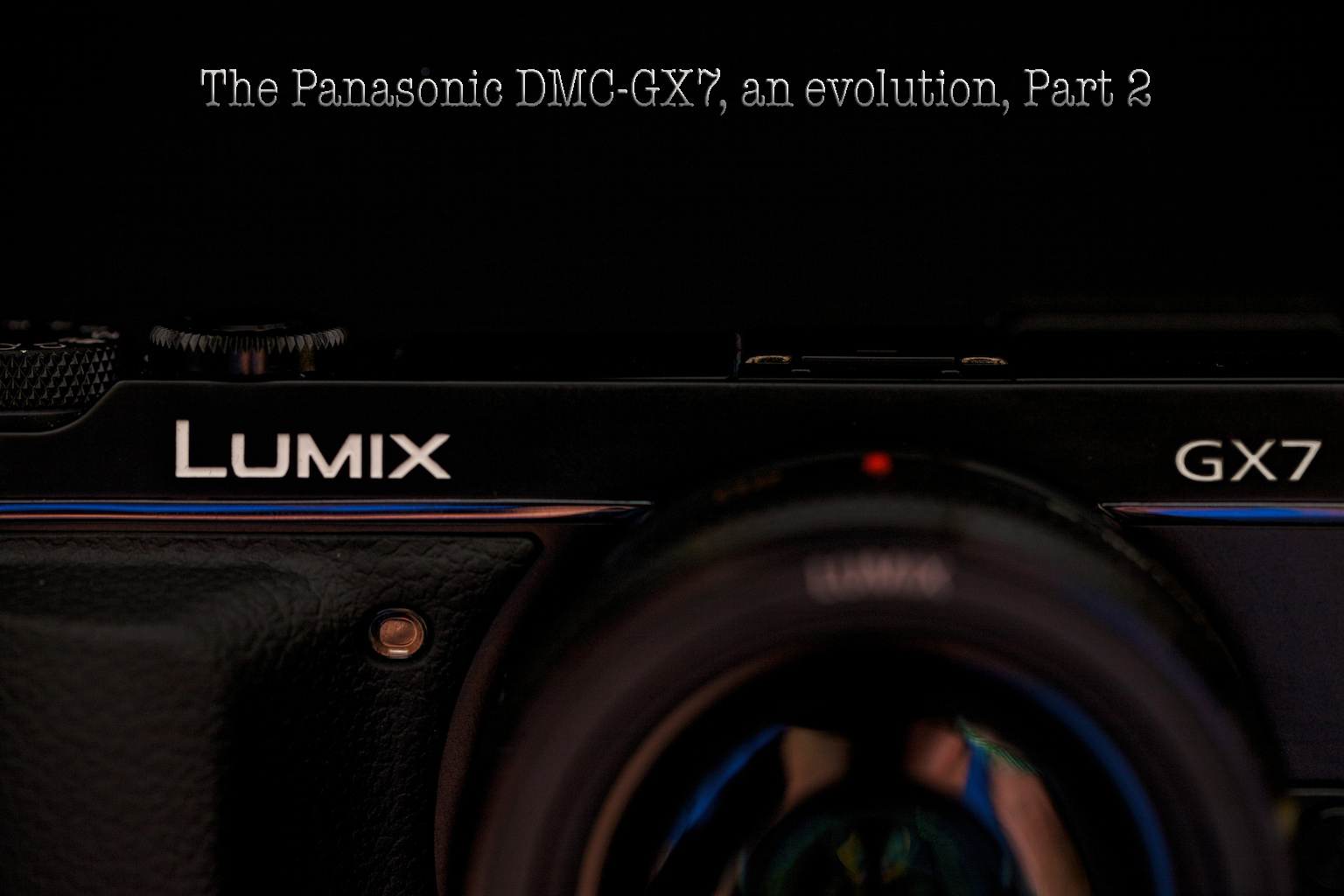
In part 1, I gave you my opinion and rundown on the physical, ergonomic changes along with a couple of the key, new features to the GX lineup. Now, we can take a look at how this camera has evolved from a performance point of view compared to the GF1 and GX1. C’mon in for some videos and comparisons…

When Panasonic started to leak the GX7 micro 4/3 camera, I, along with many micro 4/3 fans started to pine for what seemed on paper to be one of the best offerings for the system yet. Compact, nice grip, IBIS, focus peaking, a step forward in IQ, good video options, integrated EVF, WiFi, rugged chassis… I’m no fanboy, but I will admit to feeling that Panasonic has done a better job at the interface side of things, compared to Olympus in my experience with cameras from both manufacturers. If I could gain access to what I saw as Oly’s two benefits in IBIS and newer sensor tech in a Pana body with it’s more streamlined, yet still customizable interface, I had to see if it could live up to the hype. I’ve long felt that if Oly could re-engineer it’s interface and remove some of the frustrating quirks that plagued the EM5, or, if Panasonic could take a step forward in sensor performance and integrate a decent IBIS system, either could have a quintessential micro 4/3 juggernaut on their hands. Is the GX7 the answer to those desires?

PART 3: Processing your shots
After applauding your choice to invest in featherweight cameras and optics that have the image quality to rival top end digital SLR’s (well, in many scenarios anyway), it all comes down to processing, and turning those files into the beautiful images you knew they’d become. While weight is no longer a huge part of the equation, it is now time to see if we’ve compromised our ability to document our travels for posterity in all their pixel rich glory…

PART 2: Shooting your trip
You’ve already suffered through my long winded gear explanation in the previous post about gear weight in part 1. Here are some of the images and techniques I use with the gear being utilized for each shot, laid out. The above panorama shot was a handheld series of 5 frames, shot in portrait orientation using the Canon EOS-M and 22mm f/2 lens. The third and final part in this series will focus on the actual processing of the shots and won’t really have much to do with backpacking per se, nor the weight saved, but hopefully can show that with these small cameras, image quality is not compromised.

PART 1: Preparing for a trip
Have you ever had to pack for a trip, a hike, climb, vacation or another adventure where you’d be carrying everything on your back or slung over your shoulder? Gear laid out on the floor the night before leaving for the trip after having unpacked and repacked to see if you could fit everything in less space getting rid of everything you can to save weight. For those that saw their toothbrushes in half to shave off a few grams, or anyone that could stand to lose a little weight in the camera bag, this series of articles may be useful. Now, the question is, can we do this, and still carry quality photographic gear with us?
This will be the first part in a three part article focused on capturing images while backpacking and wanting to keep weight down while not compromising image quality. It is also potentially useful for any travel situation where gear weight may become cumbersome.
I’d like to thank Yukon Trading Company, Marmot, JetBoil, LEKI Trekking Poles, 43rumors.com, Expert Shield screen protectors, and B&H Photo for the continued support, and particularly for much of the stuff provided for me during this trip. Losing weight isn’t always fast and cheap, but they’ve helped make it sexy. Throughout these articles, I’ll be mentioning and linking to various products that I use(d) and highly suggest looking into. Fortunately for me, we got hooked up with companies that put quality at the top of their list. It doesn’t hurt that they also engineer some of the best, lightest and highest performing gear on the market, so, thanks guys!
Never has weight been more a factor for me than when trying to stuff all my gear into a pack with the realization that I’m going to have to carry all this stuff on my back for days on end, all while climbing, hiking and sliding around in the snow. I will start by disclosing that I am far closer to resembling a photographer than a back country, mountaineering aficionado. I’ve certainly been adventurous throughout my life, spending many nights in the elements, climbing and hiking my way to the next spot so that I may eat dried fruit, ramen and nuts for dinner, or do my best to create aches in areas I was previously unaware my body had by forgoing any type of sleeping pad or pillow. Most of the time, when I travel, or set out on any type of adventure, photography is a very large part of it, and I’ve tended to sacrifice other comforts to enable the room for my camera gear. Since adopting a mirrorless setup, I’ve not had to sacrifice at all…

One huge benefit to a smaller sensor is the effective focal length multiplier. Sure you can crop into an image captured at a wider angle, or on a larger sensor but as we have seen in the focal length vs sensor size post, when utilizing a smaller (relative to full frame) sensor, you can actually decrease your depth of field with the same focal length if shot from a fixed location, all while generically increasing your focal length by way of the effective multiplier in that smaller sensors crop into the larger image circle. Aperture is aperture as far as exposure is concerned, so even by this standard, f/5.6 is relatively quick when you consider the focal length and price. This said, is the Lumix G Vario 100-300mm f/4-5.6 (<UPDATE! click the link to see it at B&H, and if you click on “Savings Available” the price is down to $499 if you purchase one of the three things that qualify, like the $10.99 software…) worth the price of admission when you consider you get a 600mm lens able to shoot at f/5.6? Let’s see…

Sure, we’ve all seen the images that have been run through an HDR-like tonemapping, contrast increasing filter, making the grungy, saturated and contrasty images we’ve all come to accept as HDR, or at least, HDR-like shots. While the “HDR” look can bring about photographic debates bordering on political or religious polarity, there is a way to actually capture and process the actual dynamic range of a scene, not just try and make it look like a processed, HDR image. If you’re not a fan of HDR, by all means, feel free to ignore this post, but to and for me HDR can be a very useful tool, and one that, in this particular situation can help stretch a limited budget by being able to get a good range of exposure for a dynamically diverse scene without tons of lighting. Now, the trick here when wanting to do this with human subjects is that you’re needing to take multiple frames at differing exposure values, which means, in short, a person or people would need to stay statue still to make it work, right? Not so. C’mon in and I’ll show you how to get around this unfortunate challenge…
 Tyson Robichaud Photo-blography